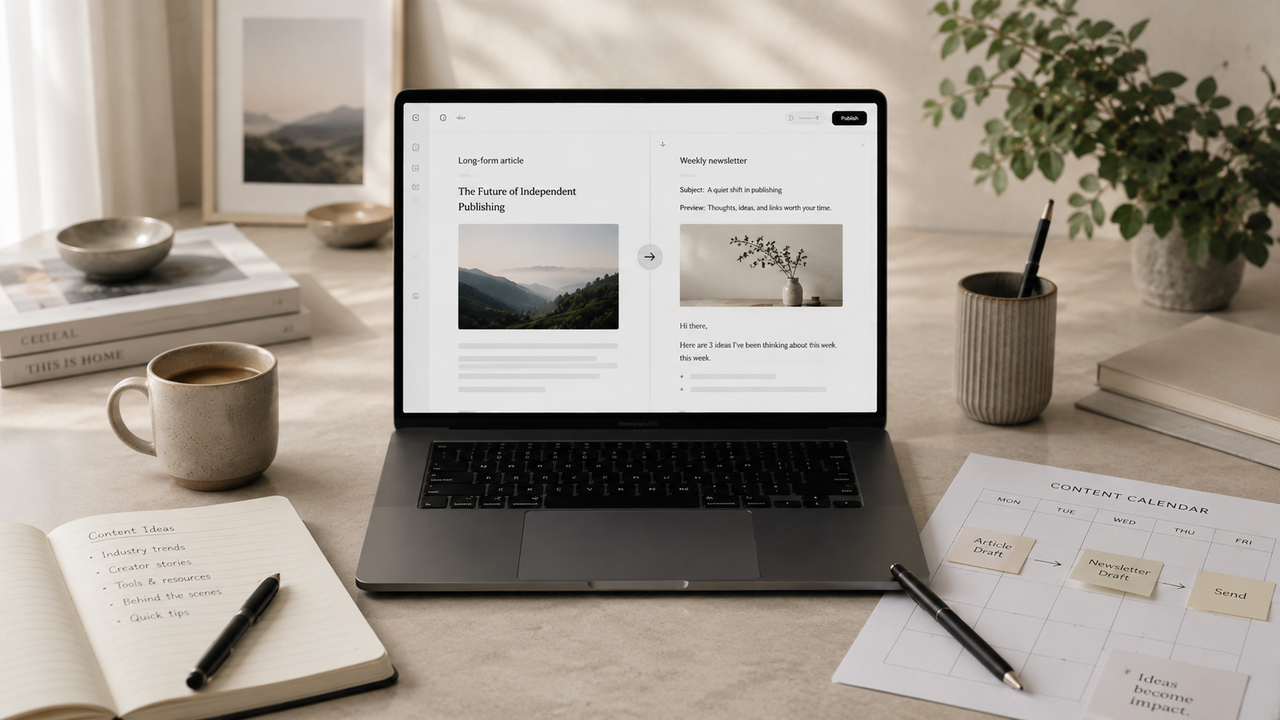
Long-form content is one of the most valuable assets an independent publisher can create.
A strong article, essay, guide, interview, or report can do more than live once on a website. It can become a newsletter, a series of social posts, a member-only resource, a podcast outline, a lead magnet, or even the foundation for a paid product.
But many creators publish long-form content once and then move on too quickly.
A better approach is to turn every important piece of long-form content into a repeatable newsletter system.
This does not mean copying and pasting the full article into an email. It means transforming the core idea into a focused, useful message that gives subscribers value and brings them back to the publication.
Start with one strong idea
Every good newsletter issue needs one clear idea.
Long-form content often contains several arguments, examples, and sections. That is useful for an article, but it can make an email feel too heavy. A weekly newsletter should usually focus on one main takeaway.
Before writing the newsletter version, ask:
- What is the strongest point in this article?
- What should the reader remember?
- What problem does this help solve?
- What action could the reader take after reading?
- What part of the article feels most useful or surprising?
If the original article is about building loyal audiences, the newsletter could focus on one idea:
“Loyalty is built through consistency, not volume.”
That idea is simple enough to explain in an email, but strong enough to make the reader think.
Write a shorter, sharper opening
A blog post can slowly introduce a topic. A newsletter needs to earn attention quickly.
The opening should make the reader feel that the email is relevant to them right now. It can begin with a problem, observation, question, or strong statement.
For example:
“Most creators do not have a publishing problem. They have a repurposing problem.”
Or:
“You may already have enough ideas for the next month. They are probably hidden inside the content you have already published.”
The goal is not to be dramatic. The goal is to create immediate clarity.
Readers are busy. A good opening tells them why the email is worth reading.
Use the article as source material, not the final draft
A common mistake is treating the article as the email.
That usually creates a newsletter that feels too long, too dense, or too passive. Instead, think of the article as raw material.
You can pull from it:
- one argument
- one example
- one story
- one framework
- one quote
- one checklist
- one practical lesson
- one mistake to avoid
Then build the newsletter around that selected piece.
The newsletter should feel like a companion to the article, not a duplicate of it.
This also gives readers a reason to click through. If the email already contains everything, the article becomes less necessary. If the email gives a useful preview, the article becomes the next logical step.
Create a simple newsletter structure
A repeatable structure makes newsletter publishing much easier.
You do not need to reinvent the format every week. A consistent structure helps you write faster and helps readers know what to expect.
A simple weekly structure could look like this:
- Short opening.
- One useful idea.
- One example.
- One practical takeaway.
- Link to the full article.
- One question or call to action.
For example:
- Opening: “Creators often publish once and move on too quickly.”
- Idea: “Long-form content should become a content system.”
- Example: “A 2,000-word article can become a newsletter, checklist, and member resource.”
- Takeaway: “Before publishing, decide how the article will be reused.”
- Link: “Read the full guide.”
- Question: “What article in your archive could become this week’s newsletter?”
This structure is simple, but it works.
Make the email useful even without the click
A newsletter should not exist only to drive traffic.
If every email is just a teaser, readers may stop opening it. The email itself should contain real value. At the same time, it should naturally invite readers to continue with the full article.
The balance is important.
A weak email says:
“Here is a new post. Click to read.”
A stronger email says:
“Here is one practical idea from this week’s essay. If you want the full framework, read the complete article.”
The second version respects the reader’s inbox. It gives value immediately and makes the click feel optional but worthwhile.
This is how trust grows over time.
Turn sections into multiple issues
One long article can become more than one newsletter.
If the article has five strong sections, each section might become a separate email. This is especially useful for evergreen topics, guides, and frameworks.
For example, an article about building a paid publication could become:
- Issue 1: Why niche audiences are more valuable than broad traffic
- Issue 2: How to define your membership promise
- Issue 3: What free content should do before the paywall
- Issue 4: How to explain paid benefits clearly
- Issue 5: Why retention matters more than launch hype
This turns one piece of research into a month of useful newsletter content.
That does not mean stretching content unnaturally. It means recognizing that one deep article often contains several independent ideas.
Add context for subscribers
Newsletter readers often want a more personal tone than website visitors.
A blog post may be polished and structured. A newsletter can include more context: why you wrote the article, what inspired it, what changed your thinking, or how readers might apply it.
This makes the email feel more direct.
You can add context like:
- “I wrote this after speaking with several creators who felt stuck.”
- “This is the mistake I see most often in small publications.”
- “This framework helped us simplify our own publishing workflow.”
- “If you only take one thing from the article, take this.”
That personal layer is one of the advantages of newsletters.
It turns content into a relationship.
Use calls to action intentionally
Every newsletter should have a clear next step, but not every next step needs to be a sale.
Possible calls to action include:
- read the full article
- reply with a question
- share the issue
- explore a related post
- become a free member
- upgrade to paid
- download a resource
- join a discussion
- view the archive
Choose one primary action.
Too many calls to action can weaken the email. A focused newsletter helps the reader know what to do next.
For a public article, the CTA might be:
“Read the full guide.”
For a member-focused article, it might be:
“Upgrade to get the full framework.”
For a relationship-building email, it might be:
“Reply and tell me what you are working on.”
The right CTA depends on the purpose of the issue.
Build a publishing rhythm
Repurposing works best when it becomes part of the publishing workflow.
Instead of finishing an article and then asking, “What should we send this week?”, plan both together.
A simple workflow could be:
- Draft the long-form article.
- Identify the strongest newsletter idea.
- Write the email version.
- Choose a subject line.
- Add a clear CTA.
- Schedule the article.
- Schedule the newsletter.
- Track replies and clicks.
This makes newsletter publishing less stressful because each article already contains the next email.
Over time, this creates a steady rhythm.
Keep a reusable idea archive
Not every article needs to become a newsletter immediately.
Sometimes a section, quote, or example is useful later. Keep an archive of ideas you can return to.
Your archive can include:
- article sections
- reader questions
- unfinished drafts
- strong headlines
- useful statistics
- personal observations
- examples
- frameworks
- common mistakes
This archive becomes a newsletter engine.
When you sit down to write, you are not starting from an empty page. You are selecting from ideas you have already collected.
The best creators do not rely only on inspiration. They build systems that capture ideas before they disappear.
Measure what readers respond to
A weekly newsletter gives you feedback.
You can see which topics get opened, which links get clicked, which emails get replies, and which ideas lead to subscriptions or paid upgrades.
Do not use this data only to chase what is popular. Use it to understand what your audience finds valuable.
Strong signals include:
- thoughtful replies
- high click-through to full articles
- new subscriber growth
- paid upgrades after specific topics
- shares from readers
- low unsubscribe rate
- returning visitors to related posts
The goal is not to let metrics control your voice. The goal is to learn what creates trust.
One article can become a system
Long-form content takes time to create. That effort should work harder.
When you turn a strong article into a newsletter, you give the idea another chance to reach readers. When you break a guide into several issues, you create a publishing rhythm. When you save useful sections for later, you build an idea archive. When you connect emails back to your publication, you strengthen the relationship between reader and site.
A newsletter is not separate from your content strategy.
It is the distribution layer, relationship layer, and trust-building layer of your publication.
The creators who understand this do not just publish more.
They make every idea travel further.