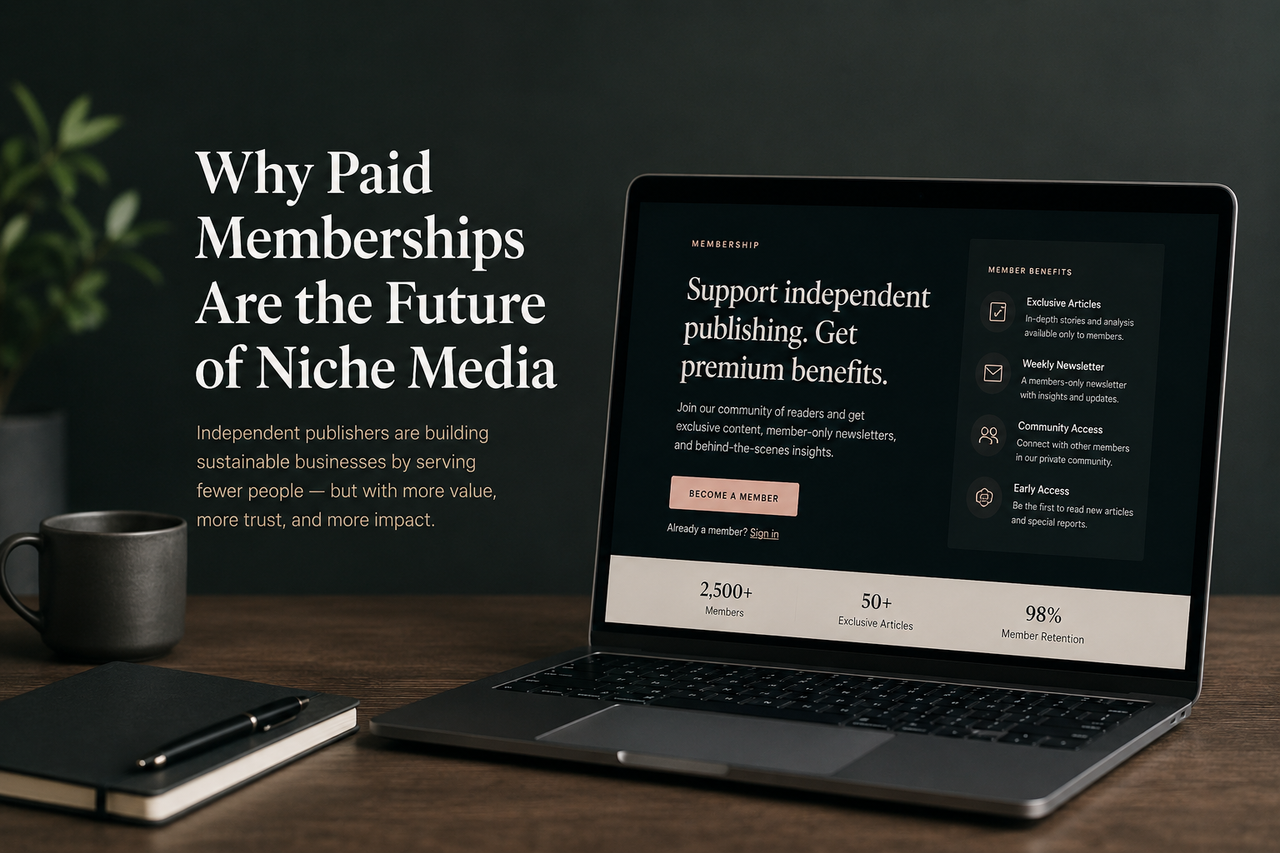
For a long time, online publishing was built around reach.
More page views. More impressions. More social traffic. More ad placements. More clicks.
But for many independent publishers, this model has become harder to sustain. Algorithms are unpredictable, advertising revenue is unstable, and broad attention is expensive to capture. At the same time, readers are becoming more selective about where they spend their time and money.
This shift creates a major opportunity for niche media.
Instead of chasing everyone, independent publishers can build deeper relationships with a specific audience. Instead of relying only on advertising, they can create direct reader revenue through paid memberships.
Paid membership is not just a monetization model. It is a different way to think about publishing.
Niche audiences value depth
Broad media is designed for scale. Niche media is designed for relevance.
A general business website might publish hundreds of articles for many types of readers. A niche publication can focus deeply on one specific audience: independent designers, climate founders, local restaurant owners, SaaS marketers, solo consultants, photographers, or any other clearly defined group.
That focus creates value.
A reader is more likely to pay when the content feels directly connected to their goals, problems, identity, or work. They are not paying for “more content.” They are paying for better context.
A niche publication can offer:
- practical frameworks
- expert analysis
- curated resources
- industry-specific insights
- private updates
- community access
- behind-the-scenes thinking
- tools and templates
When the content saves time, improves decisions, or creates a sense of belonging, membership becomes easier to justify.
Advertising rewards attention, membership rewards trust
Advertising works best when a publication can generate large amounts of traffic. That usually pushes publishers toward volume, speed, and clickable topics.
Membership works differently.
It rewards trust.
A paid member does not subscribe because they saw one viral post. They subscribe because they believe the publication will continue to deliver value over time. That requires consistency, credibility, and a clear editorial promise.
For independent publishers, this is powerful because they do not need millions of visitors to build a sustainable business.
A publication with 2,000 loyal free subscribers and 200 paid members can be more stable than a site with hundreds of thousands of casual visitors and weak monetization.
Trust compounds. Random traffic does not.
Readers want direct relationships
Many readers are tired of endless feeds.
They want fewer sources, better thinking, and more signal. A paid membership gives readers a way to support the work they value and receive a more focused experience in return.
This is especially true for creators, analysts, journalists, educators, and industry experts.
When someone subscribes to a paid publication, they are often saying:
“I want more of this perspective.”
That perspective is the product.
The strongest niche media brands are not interchangeable. Readers do not only want information about a topic. They want a trusted voice that helps them understand that topic.
This is why independent publishers have an advantage. They can feel personal, direct, and human in a way large media brands often cannot.
Membership creates more predictable revenue
Advertising revenue can change quickly.
A traffic drop, algorithm change, seasonal slowdown, or advertiser budget cut can affect revenue overnight. Paid memberships are not risk-free, but they can create more predictable monthly or yearly income.
Recurring revenue helps publishers plan.
It supports:
- better editorial calendars
- deeper research
- improved design
- more consistent publishing
- higher-quality products
- better reader experience
- long-term independence
Instead of constantly asking, “How do we get more clicks this week?” publishers can ask, “How do we create enough value that members stay?”
That question leads to healthier publishing decisions.
The best membership offers are clear
Many paid publications struggle because their offer is vague.
They say:
“Become a member to support our work.”
Support is important, but it is usually not enough on its own. Readers need to understand what they get and why it matters.
A stronger offer might be:
“Become a member to get weekly deep dives, private essays, practical templates, and early access to our publishing reports.”
This is specific. It gives readers a reason to upgrade.
A good membership page should clearly explain:
- what free readers get
- what paid members get
- how often premium content is published
- who the membership is for
- why the publication is worth supporting
- whether monthly and yearly options exist
- how members can cancel or manage their account
Clarity increases confidence.
Free content still matters
Paid membership does not mean everything should be locked.
Free content is still one of the best ways to build trust, attract new readers, and prove the quality of your thinking. The public side of a publication should act as a strong introduction to the paid experience.
The best model is often a balance.
Free content can include:
- public essays
- useful guides
- interviews
- selected analysis
- newsletter previews
- explainers
- opinion pieces
Paid content can include:
- deeper research
- premium frameworks
- private updates
- member-only archives
- templates
- case studies
- expert sessions
- community access
The free content should be valuable enough to earn attention. The paid content should be valuable enough to earn commitment.
Membership changes the editorial mindset
When a publication depends on paid members, the publisher must think differently.
Instead of asking:
“What will get the most clicks?”
the better question becomes:
“What will help our members enough that they continue to subscribe?”
This changes the type of content that gets created.
It encourages:
- depth over speed
- usefulness over noise
- trust over virality
- retention over reach
- clarity over volume
- relationships over impressions
This does not mean growth is unimportant. Discovery still matters. But the goal is not just traffic. The goal is the right readers.
Community can make membership stronger
Not every paid publication needs a community. But for some niches, community can significantly increase member value.
A community can help readers:
- ask questions
- meet peers
- share progress
- get feedback
- discuss ideas
- feel part of something
However, community should not be added just because it sounds good. A weak, inactive community can make a membership feel less valuable.
If a publisher adds community, it should have a clear purpose.
For example:
- monthly member discussions
- private Q&A threads
- expert office hours
- accountability groups
- resource sharing
- feedback sessions
The goal is not to create another noisy social feed. The goal is to create useful connection.
Design affects willingness to pay
People judge the value of a membership before they buy it.
A confusing or generic website makes paid content feel less trustworthy. A polished publication design makes the offer feel more serious and professional.
A strong membership-focused website should include:
- clear signup and sign-in links
- a simple pricing section
- easy account management
- strong article previews
- visible member calls to action
- clean typography
- fast loading
- mobile-friendly forms
- clear explanations of content access
Design cannot replace value, but it can make value easier to understand.
If the experience feels premium, readers are more likely to believe the membership is premium.
Small audiences can build real businesses
One of the biggest advantages of paid membership is that the audience does not need to be massive.
Consider a niche publication with:
- 5,000 free subscribers
- 5 percent converting to paid
- 250 paid members
- an average price of $10 per month
That is $2,500 in monthly recurring revenue.
With stronger positioning, better content, annual plans, or higher-value offers, the numbers can grow further.
This is why niche media is so interesting. A small but loyal audience can become a meaningful business if the relationship is strong enough.
The future belongs to trusted specialists
The internet does not need more generic content.
It needs better filters, stronger voices, and trusted specialists who help specific audiences make sense of their world.
Paid memberships give independent publishers a way to build around that trust. They make the reader relationship more direct. They make revenue more aligned with value. They allow publishers to serve a focused audience instead of chasing the broadest possible reach.
For niche media, that is the real opportunity.
The future of publishing may not belong only to the biggest platforms.
It may belong to the most trusted ones.